

3 October 2026 from 7.00 at the Canetti House
A LETTER THAT IS NOT PRONOUNCED, BUT CONVEYS A LOT
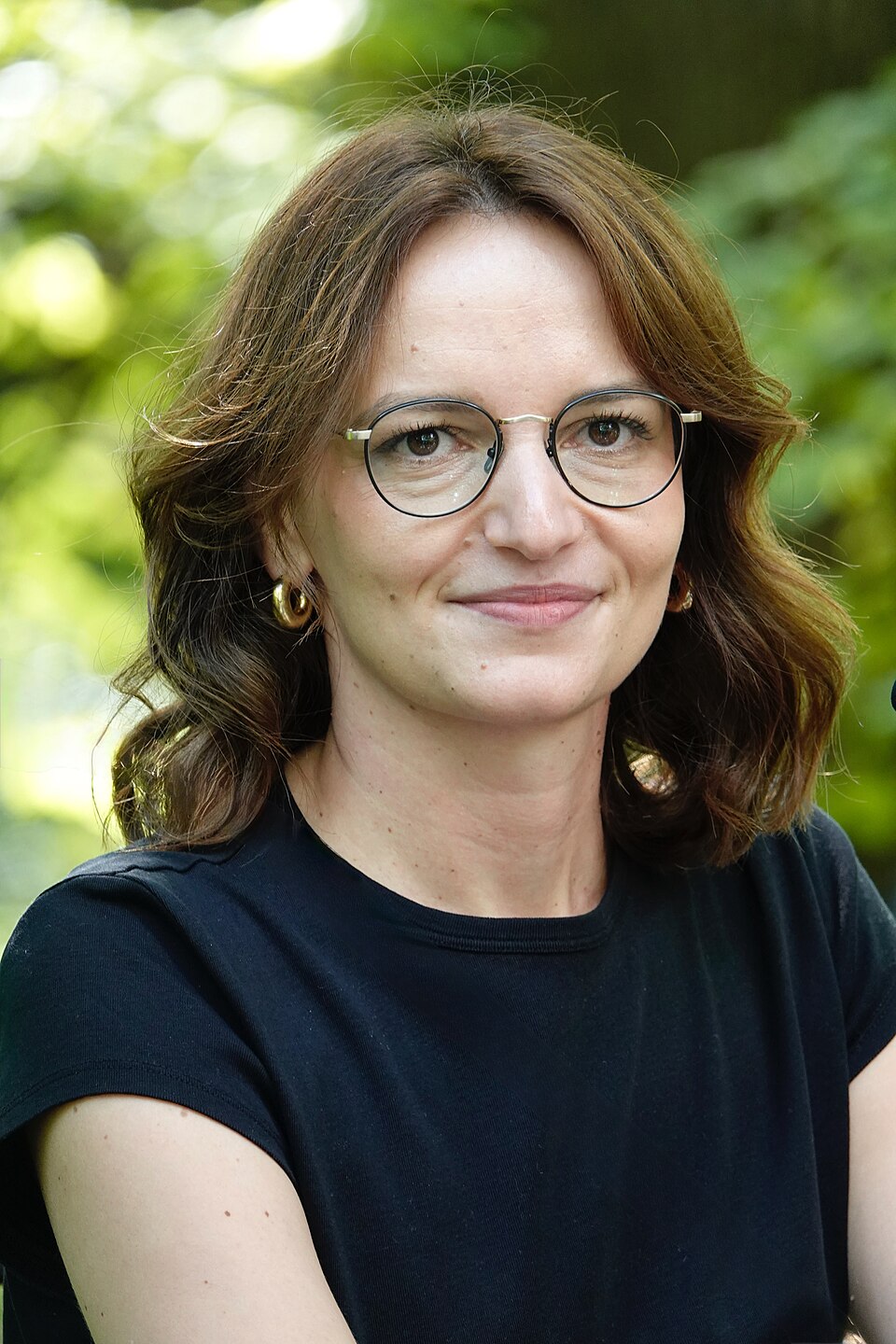
The second event on the first day of the festival features Jehona Kicaj. Kicaj was born in 1991 in Suharekë, Republic of Kosovo, and moved to Germany with her parents in the 1990s. She is a writer, editorial assistant and publisher. Her debut novel, ‘ë’, won several literary awards in 2025 and was shortlisted for the German Book Prize. In this interview with Detelina Kamenova, Jehona Kicaj gives an insight into what the audience can expect from her at the event.
DK The letter “ë” in the Albanian alphabet has a specific function – it is often “silent” (unpronounced), but it alters the sound of the surrounding words. How did this linguistic feature become a central metaphor for the experiences of Kosovar migrants in Germany?
JK The letter ë is the most striking and most common letter in Albanian texts. It is comparable to the schwa sound in German, it is a muted “e” like the one at the end of “Gedanke.” However, when it appears at the end of a word in Albanian, it is usually not pronounced at all, yet it changes the word’s pronunciation. This makes it a symbol of what my novel is about: the Kosovo War and its aftermath which is rarely discussed in Kosovo-Albanian families, but also in the public sphere of their new homelands. The ë stands for this silence and serves as a starting point for the question of what exists and makes a difference for those affected, yet has remained unspoken until now. For me as a writer, this unspoken reality has given rise to an inner urgency. I was also motivated by the artistic challenge of depicting silence in a literary text by using the very tools of language itself.
DK In the book, you write: “I come from a place that was devastated… I come from wordlessness.” How do you write a novel about the impossibility of speaking, and how can literature give a voice to what is consciously left unsaid?
JK When I as a writer seek a language for the unspoken, I hope to be able to contribute to collective memory. So for me, it’s about creating entry points: On the one hand, this applies to readers who until now may not have known much about the Kosovo War and who can now discover and experience a particular perspective on this war through my text. On the other hand, it applies to those who have direct connections to this war because they were forced to flee, because they suffered losses in their families, or because their parents lived through this war but have hardly spoken about it until now. For me, remembering definitely means acknowledging the experienced suffering and understanding the past to better shape the present.
DK The text moves smoothly between German, Albanian, and English. Were you intentionally looking to make the reader feel the tension of translation and a constant sense of not belonging?
JK It was incredibly important to me to include passages in Albanian in the novel, but to always translate them into German afterward. On the one hand, I wanted to make clear that the protagonist’s family doesn’t speak German among themselves, on the other hand, I also wanted to give the audience access to these conversations. However, the Albanian always serves as a moment of disorientation – at least for readers who are suddenly confronted with a language they don’t understand. Of course, I hope that this allows readers to briefly empathize with the protagonist’s experiences. I especially appreciate that I’m often asked about the Albanian passages after readings, because for many people, it’s only through hearing them spoken out loud that it becomes clear how the words are actually pronounced.
DK The novel begins with a powerful physical image – the unnamed protagonist finds pieces of a broken tooth in her mouth due to nighttime teeth grinding (bruxism). Why did you choose dental chairs as the framework within which a past of war unravels?
JK That’s right – I’m telling the story of a young woman who wakes up one morning to find a small piece of tooth on her tongue. Her dentist then points out to her that her nighttime teeth grinding is so intense that she runs the risk of eventually being unable to speak without pain. She therefore asks herself what there might be to tell and what she needs to talk about before it’s too late. And then, bit by bit, she begins to tell her story.
DK The protagonist experiences the Kosovo war of the late 1990s from a safe distance in Germany. What does it feel like to grow up in the shadow of a war that is happening “over there,” yet is present in the bones and daily life of your family at home?
JK It is precisely this perspective that I have found lacking in German-language literature so far. And for me as a writer, it presents a special challenge to find a language for something, no language has yet been found for. My protagonist came to Germany with her family in the early 1990s as a toddler. She therefore experiences the 1998–1999 war not only from a safe distance, but as a child who doesn’t fully understand everything that’s happening yet, but carries a sense of that time with her. This results in numerous gaps that the now adult protagonist tries to shed light on in retrospect. In addition, however, her memories of the war overlap with the experiences shaped by her migration to Germany: exclusion, stereotypes, open racism, and a lack of understanding the war that was raging in Kosovo at the time.
This creates a highly complex interweaving of events, because she also experiences how the war is viewed in Germany. In short: I was interested in a specific form of involvement that lies between firsthand experiences of war and detached observation from abroad. The complexity of all this required a literary form, which I hopefully have found in my novel.
DK You yourself were born in Kosovo in 1991 and grew up in Göttingen. To what extent does the experience of your unnamed protagonist overlap with your own personal journey through kindergarten, school, and university in Germany?
JK I’m asked this question time and time again, which I can absolutely understand given the parallels between the protagonist and me. But it’s important to note that “ë” is a novel – albeit an autofictional one. So, on the one hand, I draw on my own experiences, but on the other hand, I also very consciously take advantage of the creative liberties that come with writing a fictional text, both in terms of content and form. Let me give an example: Gaps and unanswered questions not only preoccupy the protagonist but were also the starting point for me to write this novel and to engage with the topic more deeply and over a longer period of time. When the book deals with the protagonist’s research and investigations, these overlap to a certain extent with my own work on the book. In the novel, however, all of this takes on a different context and its own literary form.
DK The protagonist is educated and articulate, yet she still feels like an outsider. Do you believe that the prejudices and ignorance of the majority can be overcome by sharing personal stories, or are they deeply rooted?
JK Ich glaube an die Macht der Literatur. Sie ermöglicht das Eintauchen in eine subjektive Perspektive, die eigene Verwandlung im Moment der Lektüre. Vor allem fordert sie aber etwas ganz Grundsätzliches: das Zuhören, ohne die Erzählerin unterbrechen zu können. Und wenn die Komplexität dieser Perspektive erst einmal erfahren wurde, dann geht es um das Weiterdenken, um das Hinterfragen der eigenen Position und natürlich auch des Gelesenen, letztendlich also um eine Fortsetzung des Diskurses. Literatur wird so zum Teil einer kollektiven Auseinandersetzung und im Falle meines Romans eben auch: zu einer spezifischen Form des kulturellen Gedächtnisses.
I believe in the power of literature. It allows us to immerse ourselves in a subjective perspective and to transform ourselves in the moment of reading. Above all, however, it demands something very fundamental: listening without being able to interrupt the narrator. And once the complexity of this perspective has been experienced, the focus shifts to further reflection, to questioning one’s own position and, of course, what has been read – ultimately, to a continuation of the discourse. Literature thus becomes part of a collective dialogue and, in the case of my novel, also a specific form of cultural memory.